Home / Winter night sky
Reading the northern winter sky: Orion, Cassiopeia and the pole.
Winter is the season most northern observers return to. The nights are long, the cold air is often dry and steady, and the brightest patch of sky most people ever see — the region around Orion — climbs high after sunset. From the latitudes of southern Canada the winter constellations are visible from roughly late December to late March in the evening; further north the dark window opens earlier and lasts longer.
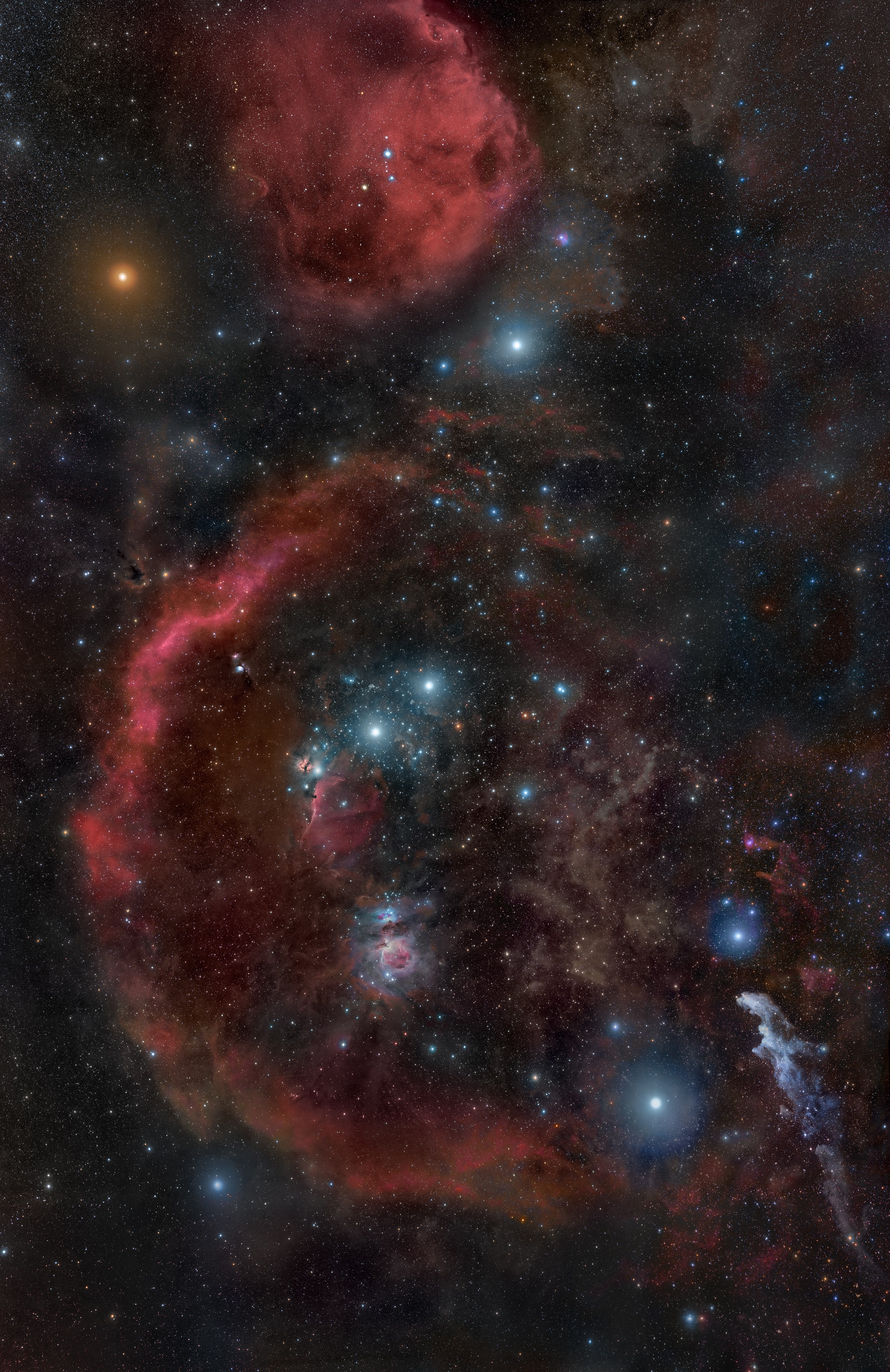
Start with Orion's Belt
Orion rises in the east after sunset and is unmistakable: three medium-bright stars in an almost straight line form the Belt — Alnitak, Alnilam and Mintaka. Above and below the Belt sit the four corner stars that outline the figure: orange-red Betelgeuse at the top-left shoulder and blue-white Rigel at the bottom-right foot are the two brightest. The colour difference between them is easy to notice with the naked eye on a clear night.
Hanging below the Belt is the Sword. The middle "star" of the Sword is not a single point but the Orion Nebula (M42), a star-forming region close enough and bright enough to appear as a soft, fuzzy patch to the unaided eye from a dark site. A pair of 10×50 binoculars turns it into a distinct grey glow.
Belt as a pointer
Follow the line of the Belt down and to the left and you arrive at Sirius in Canis Major, the brightest star in the entire night sky. Extend the Belt up and to the right and you reach Aldebaran, the orange eye of Taurus, and beyond it the tight knot of the Pleiades star cluster.
The wider winter pattern
Once Orion is fixed, the rest of the winter sky falls into place. These constellations share the evening sky through the cold months at northern latitudes.
| Constellation | Look for | Notable object |
|---|---|---|
| Orion | Three-star Belt, bright Betelgeuse & Rigel | Orion Nebula (M42) |
| Canis Major | Sirius, low and dazzling below Orion | Open cluster M41 |
| Taurus | The V of the Hyades and orange Aldebaran | The Pleiades (M45) |
| Gemini | The twin stars Castor and Pollux | Open cluster M35 |
Turning north: the circumpolar stars
The northern sky behaves differently. A group of constellations close to the celestial pole never sets from Canadian latitudes — they are circumpolar, wheeling around Polaris, the North Star, all year long.
The easiest way to find Polaris is the Big Dipper, part of Ursa Major. The two stars at the outer edge of the Dipper's bowl, Dubhe and Merak, are the "pointers": draw a line through them and continue about five times their separation to reach Polaris. Because Polaris sits almost exactly at the north celestial pole, its height above the horizon roughly matches your latitude — a useful, low-tech bearing on a clear night.
Cassiopeia, on the other side of the pole
Opposite the Big Dipper, across Polaris, lies the bright "W" (or "M", depending on the season and your viewing angle) of Cassiopeia. It is also circumpolar and sits within the band of the Milky Way, so sweeping any of its five stars with binoculars reveals a sky thick with faint stars.
Pick a moonless night, give your eyes half an hour to adapt, and the same few signposts — Orion's Belt, the Big Dipper's pointers, the W of Cassiopeia — will orient you anywhere in the northern sky.
Practical notes for cold-weather observing
- Time it with the Moon. The faint targets — the Milky Way band, M42, the Pleiades — show best near new Moon, when there is no moonlight washing out the sky.
- Dress for stillness. Standing still in winter is far colder than walking. Layers, insulated boots and a warm hat matter more than any optic.
- Let optics cool. Binoculars and telescopes brought from a warm room will fog; give them time outside before observing.
- Start wide. Low magnification and wide fields suit clusters like the Pleiades and the whole Sword of Orion far better than high power.
For seasonal sky maps and observing programmes, the Royal Astronomical Society of Canada publishes resources aimed at Canadian observers. Continue with the companion guides on Canada's Dark-Sky Preserves and watching the aurora borealis.